

IEC C13 vs. C14 vs. C19 vs. C20: What’s the Difference?
Not all power cables are created equal. There are important differences between them for both functionality and safety.
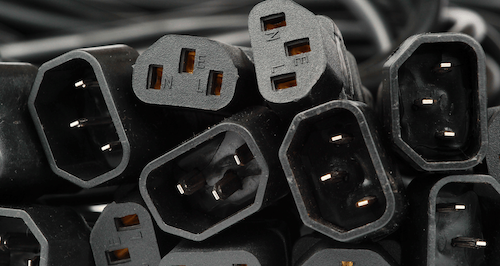
IEC C13, C14, C19, and C20 are standardised power connectors defined by the International Electrotechnical Commission (IEC) to supply power to electrical equipment. The main differences between connectors lie in their current ratings and physical sizes. This is done to prevent potentially dangerous cross-connection of mismatched power loads. The odd numbers (C13/C19) are female connectors and even numbers (C14/C20) are male appliance inlets.
Having the correct cable configuration is important because they determine how safely and efficiently your servers, switches, and storage equipment receive power. Get this detail wrong and you run the risk of overheating, accidental disconnects and equipment damage.
What Is the IEC 60320 Standard?
The IEC 60320 standard is an international set of specifications from the International Electrotechnical Commission (IEC) that defines non-locking appliance couplers, commonly referred to as plugs, used to connect detachable AC power supply cords to electrical equipment.
Having an international standard simplifies design and production because manufacturers can build a single device and use region-specific wall power cords just by changing the outer cable. The IEC 60320 standard covers electrical devices operating up to 250 volts (AC) and typically up to 16 amperes (A or Amps), classified by temperature tolerances (cold at 70°C, hot at 120°C, and very hot at 155°C).
Connectors are denoted by the letter ‘C’ followed by a number. The female connectors on the cord end have even numbers, while male appliance inlets on the device end use the next odd number up, for example, C13 is the female end and C14 the male.
C13 vs. C14: Connector and Inlet Explained
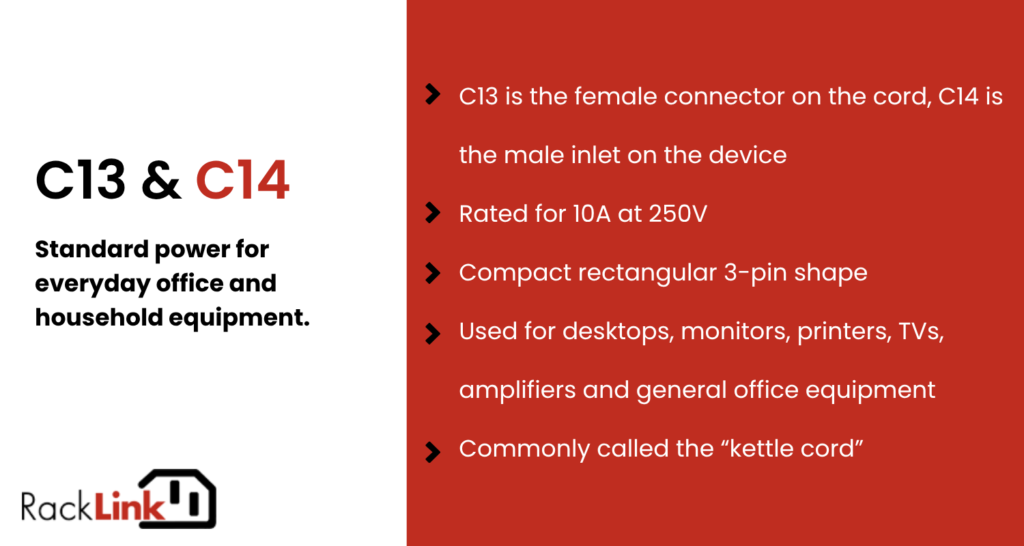
An IEC C13 power connector is a standard 3-pin female socket and the IEC C14 is a the 3-pin male equivalent. They are rated for up to 250V and 10A, and widely used for desktop computers, household appliances, monitors, amplifiers, printers, televisions and general office equipment. The pin configuration consists of a 3-wire connection. One wire is Active/Hot, another is neutral, and the third is the Earth/Ground.
C19 vs. C20: The Higher-Rated Counterpart
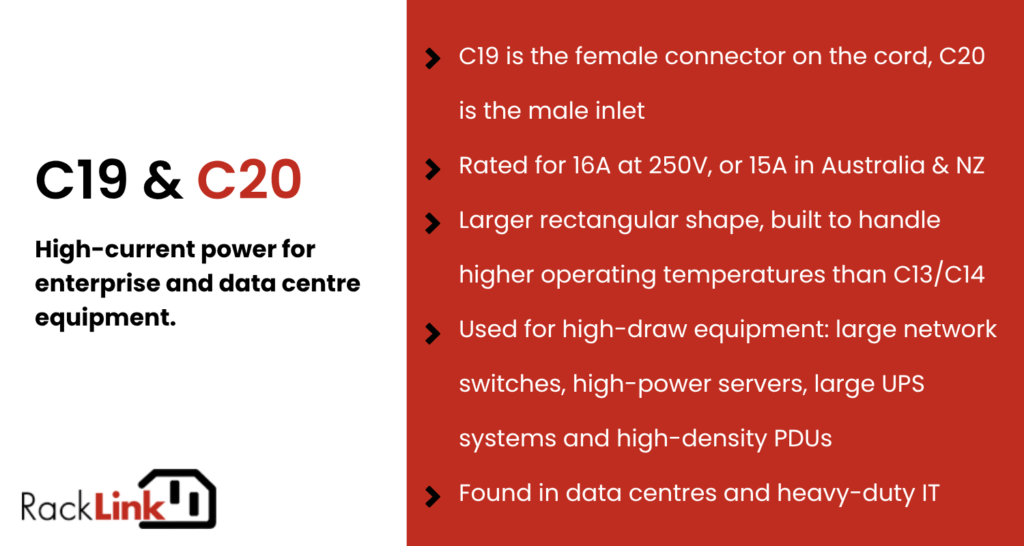
The IEC C19 is a high-current, 3-pin, female rectangular power connector and the IEC C20 is the male equivalent. The IEC C19/20 is designed to handle higher operational temperatures than standard desktop IEC C14 connectors and are rated for up to 16A (international) or 15A (in Australia/New Zealand) at 250V. The IEC C19/20 is used for heavy-duty, high-draw enterprise equipment including large network switches,high-power servers, large UPS (Uninterruptible Power Supply) backup systems, and high-density PDUs (Power Distribution Units).
Unlike the smaller, lower rated C13/C14 connectors, C19/C20 pins are horizontally aligned in a distinct rectangular-yet-rounded shape with rectangular, parallel blades, perpendicular or angled relative to each other depending on the specific slot orientation. This ensures they can’t be cross-connected with lower-rated 10A cords.
Key Differences Between C13/C14 and C19/C20
The main difference between the C13/C14 and C19/C20 IEC connector pairs is their current capacity and physical size. The C13/C14 is rated for 10A, designed for standard, everyday electrical loads, and is a smaller, compact rectangular 3-pin configuration. Whereas the C19/C20 is rated for 16A, built for heavy-duty, high-draw electrical loads and has a noticeably larger and wider rectangular 3-pin shape. The size difference between the two is intentional to prevent an under-rated cord from overloading on a high-current circuit.
Common Applications for Each Connector Type
The IEC C13/C14 connector is commonly called a ‘kettle cord’ and used in household appliances, televisions, computers, vacuum cleaners, printers, audio/visual gear and mall-to-medium Uninterruptible Power Supplies (UPS 600VA–2.2KVA).
The IEC C19/C20 connector is commonly used in enterprise level electrical equipment such as high-power blade servers and enterprise data storage arrays, as well as high-capacity Power Distribution Units (PDUs) in data centres, heavy-duty professional IT and industrial workstations.
Final Thoughts
For most people, the IEC C13/C14 connectors are encountered on a daily basis. They’re the most common plugs in households and office environments. However, for those working in environments where high draw equipment is used, such as network administrators, data centre technicians, engineers and commercial electricians, the C19/C20 plugs are likely to be used in equipment they encounter.
The key differences between the IEC C13/C14 and IEC C19/C20 lie in the design (Size and shape) and their load capacities. Each female plug type will only connect to the male equivalent, creating a safer system that is further strengthened by them being standardised by the International Electrotechnical Commission (IEC) and therefore used universally around the world.