

What is Data Centre Cabling? Structured Cabling Guide
Posted by RackLink on May 15, 2026
What is Data Centre Cabling?
Data centres provide the physical infrastructure required for online data storage, transfer, and processing. Each data centre consists of hundreds of devices for power distribution, data storage and transfer, and network connectivity - which are all interconnected via a range of cables.
Managing cable connections is a critical part of ongoing maintenance and organisation in data centres, server farms and telecommunications facilities.
This guide to data centre cabling offers cable management best practices to improve uptime and efficiency.
What Does Data Centre Cabling Involve?
Data centre cabling involves maintaining an efficient and organised cable system.
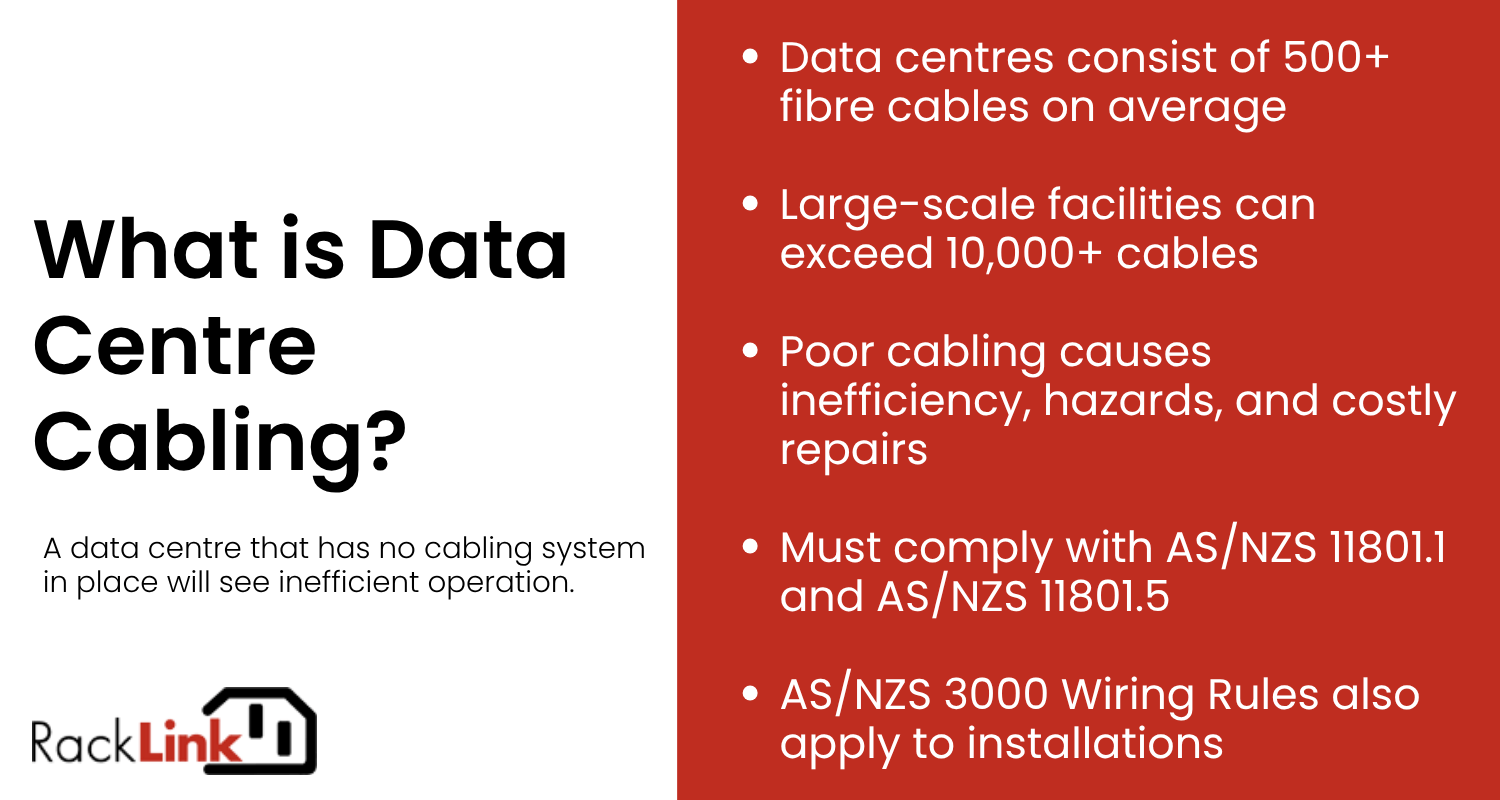
Most data centres have over 500+ fibre cables for connectivity. Large-scale industrial data centres easily consist of 10,000+ cables between devices. At such a scale, planning data centre cabling for connection points for each cable, cable positioning and length, and the appropriate type of cables is necessary.
A data centre that has no cabling system in place will see inefficient operation, electrical fire hazards, and expensive maintenance work.
Cabling systems in Australian data centres must comply with national standards, specifically the AS/NZS 11801.1 (general structured cabling) and AS/NZS 11801.5 (requirements for data centres). The AS/NZS 3000 (Wiring Rules) also apply to the physical installation environment.
How to Create and Implement a Structured Cabling System
A structured cabling system is a scaled approach to cable management and organisation. Each facility may require a different structured cabling system based on layout and infrastructure - but the core principles remain the same.
1. Cable System Planning
Conduct a site survey to map the physical layout of the facility. Include equipment placement, and assess distance between access points and device endpoints. Modern structured cabling follows a hierarchical model with layers across the main distribution area (MDA), horizontal distribution areas (HDA), and the equipment distribution areas (EDA).
Rack and equipment placement must follow these areas - enterprise-level facilities require the expertise of a BICSI-credentialed designer (RCDD) or similarly qualified engineer to develop the cabling plan.
2. Cable and Hardware Selection
There are two main types of cabling - copper and fibre.
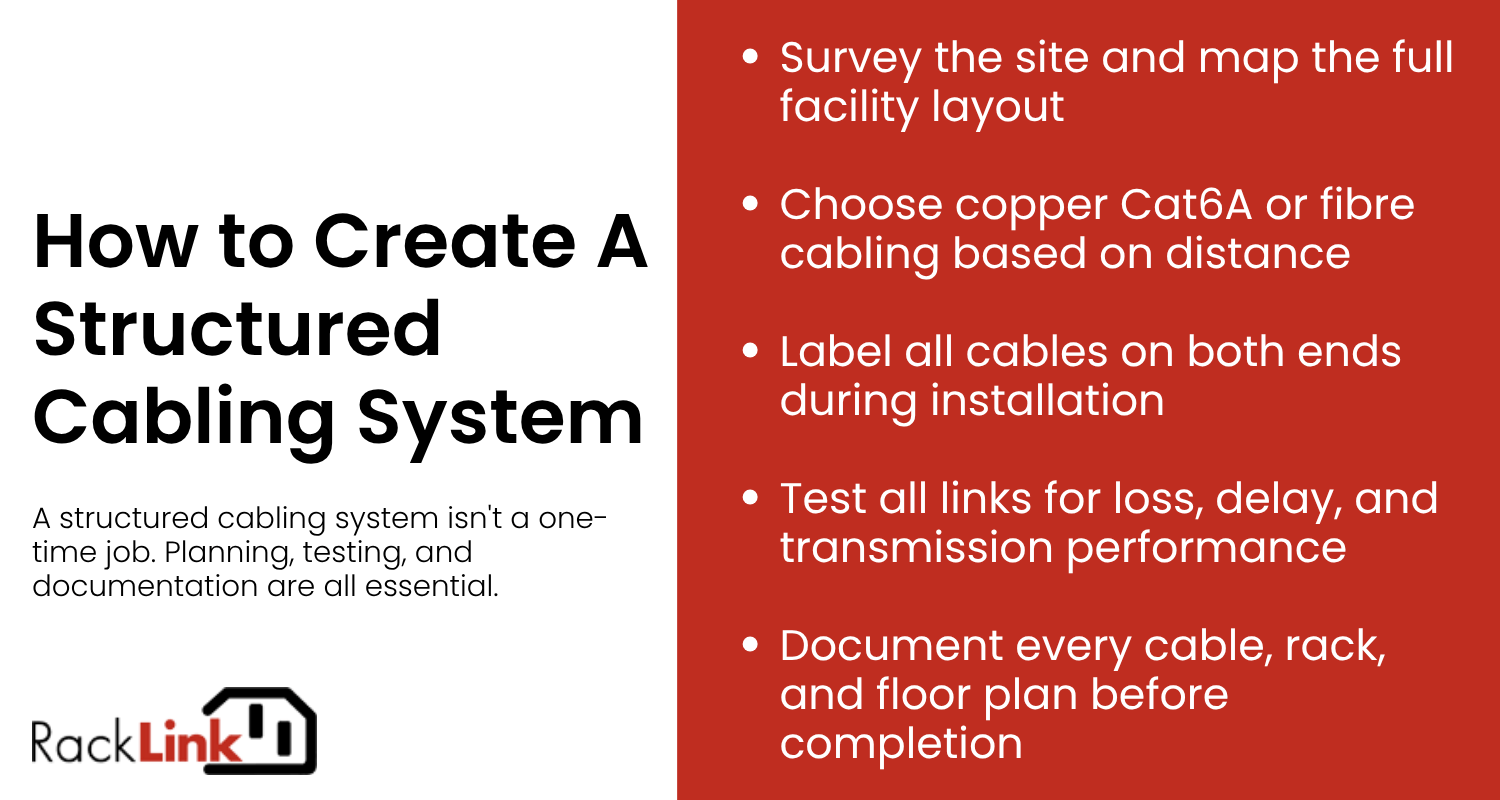
Copper Cat6A (Class EA) is the minimum recommended category for data centre horizontal cabling at 100m or under.
Fibre cabling (OM4 or OM5 multimode fibre) is the standard for structured cabling in data centres for distances up to 400m, providing data transfer speeds of 40/100 Gbps. Single-mode OS2 fibre is used for longer distances beyond 400m.
There are significantly more variations of copper and fibre cabling options, each designed for compatibility with devices. Cable selection will depend on the recommended specifications for devices used — including peripherals such as monitors, external drives, and docking stations that consolidate multiple connections through a single interface.
3. Installation Considerations
Once the cables, devices, and racks are prepared for installation, the facility can be set up in line with the cabling plan.
Racks need to comply with AS/NZS 11801.5 dimensional recommendations and be earthed as per AS/NZS 3000. A minimum space of 1U should be left for horizontal cable management for every 2U of patch panel.
There should be no more than 48 ports per 1U of patch panel to ensure serviceability.
All cables should be labelled on both ends during installation to facilitate future maintenance or cable replacement work. Colour-coding cables for different zones or connection types can minimise guesswork for repairs, especially if dual supply PDUs are used for redundant power supply.
Data cables should not cross or restrict active airflow paths, as this can lead to cooling issues for equipment. There should be ample consideration for the maximum bending radius and pulling tension of cables - each manufacturer will specify this limit.
4. Testing and Troubleshooting
All installed links and channels must be tested for length and propagation delay, insertion and return loss, and optical loss to the appropriate level of transmission performance required.
Testing is typically outsourced to a certifier who can provide troubleshooting in optimising the cabling system.
5. Documentation
Before the cabling work is complete, the following aspects of the cabling system and facility infrastructure need to be documented:
- Floor plans with all outlet, panel, and rack locations
- Cable schedule listing every cable ID, origin, destination, length, and test result reference
- Rack elevation drawings
- Fibre connector inspection records
- Test result files (native and PDF)
- Earthing and bonding schedule
- Fire-stopping register
6. Ongoing Maintenance
Structured cabling will still require consistent maintenance in future to fix connections or replace damaged components.
Additions of new equipment will also result in changes to the cabling system to accommodate new layouts.
RackLink provides custom power cables and connectors suitable for data centre equipment and server racks. We work with commercial and enterprise-level clients to supply Australian standards-compliant rack mounted equipment, PDUs, power strips and cables for optimal electrical performance.