


Heat Load Calculation For Server Racks
Heat load calculations for server racks are relatively straightforward, because nearly all of the electrical energy consumed inside a server room converts directly into heat. This means it is possible to accurately determine the cooling requirements of a server and have confidence that what you have in place is adequate for your needs.
What Is Server Rack Heat Load?
Server rack heat load is the total amount of thermal energy, or heat, generated by IT equipment, power distribution, and surrounding infrastructure inside a server rack that must be removed by an air conditioning or cooling system to prevent damage and allow safe operation.
Almost all electrical power consumed by servers, network switches, and storage drives inside a rack converts directly into heat. Unlike a traditional home or office Heating, Ventilation, and Air Conditioning (HVAC) system, server room heat load does not depend on outdoor weather, sunlight, or building insulation, it is almost entirely determined by power consumption.
Main Sources of Server Rack Heat
The main source of server rack heat is IT equipment (80–90% of load). Every watt of electricity that servers, storage arrays, network switches, and patch panels draw turns into a watt of heat. Power distribution units and uninterruptible power supplies lose a small percentage (typically 2% to 8%) of energy as waste heat during conversion. A very small amount of server rack heat is generated by lighting, KVM switches, management modules, and network gear also within the space.
Server Rack Heat Output by Rack Density
Heat load is generally measured in watts (W), kilowatts (kW), or BTUs per hour (BTU/hr) where 1 kW ≈ 3,412 BTU/hr.
A standard enterprise rack of 3–5 kW will produce approximately 10,000 to 17,000 BTU/hr. A medium-density rack of 7–10 kW produces about 24,000 to 34,000 BTU/hr. A high-performance/AI/GPU Rack of 20–50+ kW Produces 68,000 to over 170,000 BTU/hr.
How to Calculate Server Rack Heat Load
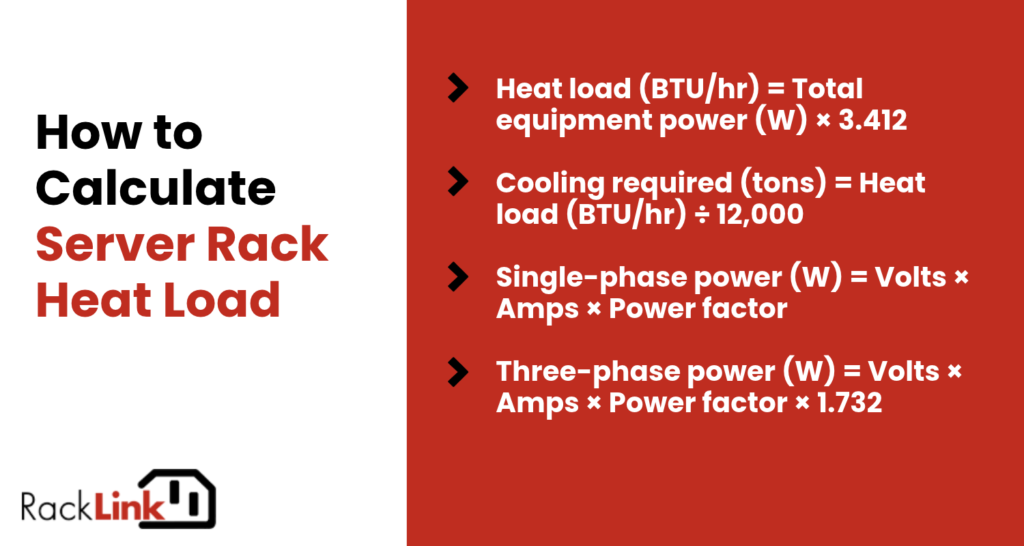
Calculating the heat load of a server rack comes down to the fundamental rule, that virtually all electrical power consumed by IT equipment in a server converts into heat.
Heat load (BTU/hr) = Total equipment power (W) × 3.412
Cooling required (tons) = Heat load (BTU/hr) ÷ 12,000
Single-phase power (W) = Volts × Amps × Power factor
Three-phase power (W) = Volts × Amps × Power factor × 1.732
Server Rack Heat Load Calculation Example
As an example, a standard enterprise rack drawing 5kW (5,000W) produces 17,060 BTU/hr. This is calculated as: 5,000 x 3.412. The tons of refrigeration is then calculated as 17,060 ÷ 12,000, which equals approximately 1.42.
(5,000 W × 3.412) ÷ 12,000 ≈ 1.42 tons
Factors That Affect Server Rack Heat Output
The heat output of server racks is primarily caused by power-to-heat conversion, as almost every watt of electrical power delivered to rack-mounted IT equipment converts directly into heat. However, there are other factors that can lead to inefficient cooling, increased heat production and poor natural heat dissipation.
High-performance computing, such as using intensive databases, and local AI or machine learning workloads can push processors to draw maximum electrical power for extended periods, which scales up heat output linearly.
Densely packing servers without gaps concentrates thermal energy (heat) and reduces natural airflow and the ability of cooling systems to work efficiently. Whereas leaving 1U or 2U spaces or distributing high-heat/high-draw components evenly throughout the rack improves airflow and prevents heat accumulation at the top of the rack.
Misaligned gear or equipment mounted in opposing directions, such as sideways or rear-facing units, disrupts standard front-to-back chassis cooling, causing turbulence and hot-exhaust recirculation. This can trap the hot air and lead to cooling fans to work ineffectively.
Positioning server racks near external heat sources, like windows, can greatly increase localised thermal hot spots. Also, messy or congested cabling, particularly if near air intakes, blocks exhaust paths and prevents intakes from being able to draw cool air.

How to Size Cooling for a Server Rack
To size cooling for a server rack, you need to calculate the total heat output of your IT equipment and then match it with the correct cooling capacity and method to suit your needs. It’s important to adequately cool your server rack to prevent damage to equipment caused by overheating.
The per-rack heat load determines what kind of cooling technology is required. For servers with up to 10 kW per rack, traditional room-level Computer Room Air Conditioning (CRAC) units can manage the heat load.When you move up to 10 to 20 kW per rack, you will likely require in-row cooling units or close-coupled air cooling to prevent excess heat in equipment of high energy draw. Once you move above 20–50+ kW per rack, such as AI and high-performance GPU’s, air cooling is no longer effective, and you will possibly require direct-to-chip liquid cooling or immersion cooling.